Ticket deflection is a knowledge problem, not a chatbot problem
Deflection projects buy a chatbot and stall at the same rate. The bottleneck isn't the interface - it's whether the answer exists anywhere at all.
At some point, every support leader is handed the same project: get the ticket volume down. And nearly every version of that project starts in the same place - evaluating chatbots.
Fair enough. "Deflection" is the industry's word for the goal, chatbots are the industry's answer, and the demos are genuinely impressive. So the bot ships, the deflection dashboard shows a healthy number - and then the strange part happens. The tickets that actually made support expensive keep arriving. Some of them arrive angrier than before.
There are two kinds of deflection
A chatbot keeps a ticket out of your queue in one of two ways.
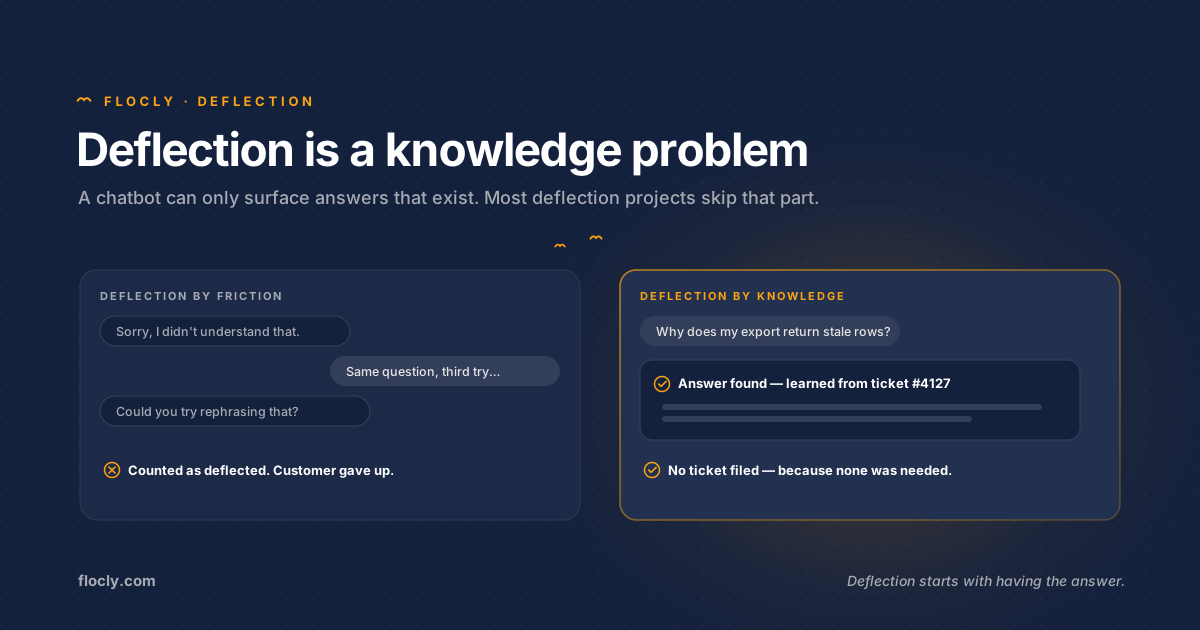
The first is by answering. The customer asked, the answer existed, the bot found it. No ticket, and a customer who got unblocked in thirty seconds. This is the deflection you wanted.
The second is by exhausting. Three rephrasing loops, two "did this help?" prompts, one link to a doc that almost applies - and the customer gives up. No ticket gets filed, so the dashboard counts a deflection. The customer counts something else. A few of them quietly count themselves out of renewing.
The uncomfortable part: your dashboard cannot tell these two apart. Both look like a conversation that ended without a ticket. That's how deflection projects get declared a success in the same quarter that CSAT starts drifting down.
The dependency chain nobody audits
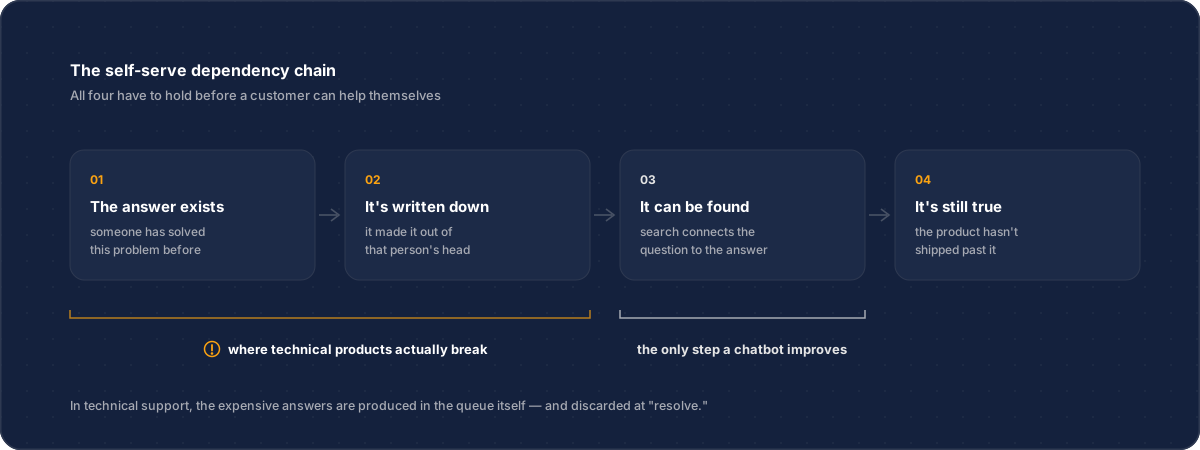
For a customer to genuinely self-serve, four things have to be true, in order:
- The answer exists. Someone in your organisation has solved this problem before.
- It's written down. The solution made it out of that person's head into something a machine can read.
- It can be found. Search, navigation, or a bot can connect this customer's question to it.
- It's still true. The product hasn't shipped past it.
A chatbot - even an excellent one - operates on step 3. That's the entire pitch: better retrieval over whatever corpus you point it at. Which is real value, right up until you ask what happens when steps 1, 2, or 4 fail. Then the best retrieval in the world retrieves nothing. Confidently.
Technical products break at step 2
Here's why this bites technical products specifically.
Your docs describe how the product is supposed to work. But look at what actually fills your queue: it isn't "how does this feature work" - it's "why is it doing this." Edge cases. Version interactions. The webhook that behaves differently on the legacy plan. The expensive tickets live in the gap between documented behaviour and actual behaviour, and documentation, by definition, doesn't cover that gap.
The knowledge that would deflect those tickets is being produced constantly - in the queue itself. Every resolved ticket is a verified answer to a real question: the actual problem, the actual cause, the reply that actually worked. And in most teams, that answer is discarded the moment someone clicks "resolve." It survives only in the head of whoever closed the ticket, and in a thread nobody will find again.
So the next customer with the same problem meets the chatbot. The chatbot searches the docs. The docs never contained the answer - it only ever existed in ticket #4127.
A better search engine over an empty library is still an empty library.
What actually moves the number
The teams with genuinely high self-serve rates aren't the ones with the best bot on the front door. They're the ones with a working supply line behind it: solved problems become findable knowledge as a side effect of doing the work, not as a documentation project someone gets around to each quarter.
That ordering matters. Fix the supply side and almost any decent interface on top of it performs. Skip it, and the interface is a prettier way to say "no results."
That supply line is what Flocly's memory is built to be: when your team resolves a ticket, Flocly distils what was learned - problem, root cause, resolution, evidence - into knowledge the whole organisation can reuse, automatically, at the moment the answer is freshest. We've written about how that works in No answer should be learned twice.
Deflection starts with having the answer. See how Flocly turns resolved tickets into reusable knowledge.